Informatory road signs in Kenya: what they mean and what to do
Road signs
- Rectangle
- Directions and information
- Services: fuel, toilets, food
- Parking and the bus stop
How do I read an informatory sign while driving?
Our informatory signs guide gives the rules. Our shapes and colours guide compares the three groups.
- Step 1: Spot the shape. Circles give orders and triangles warn, while informatory signs are rectangles.
- Step 2: Check the colour. Green is direction or information, brown is a service, blue is parking or the bus stop.
- Step 3: Read it early, so you are in the right lane and at the right speed well before your turn.
- Step 4: Act on it: get in lane, slow down or choose your exit.
Good to know: Treat a direction sign as a map. Reading it early is what lets you choose your lane calmly.
Which signs help me find the way?
| Sign | What it tells you | What you do |
|---|---|---|
| Direction sign at a junction | Which way to go for each town or route | Read it early and get into the right lane |
| Direction sign before a roundabout | The exits of the roundabout and where each leads | Choose your exit early and get into the right lane |
| Lane pre-selection sign | Which lane to use for each direction at the junction ahead | Get into the lane for your direction early |
| Distance sign | The distance remaining to a destination | Use it for navigation and travel time |
| Town name sign | The name of the town you are coming into | Check where you are on your route |
| Exit sign | An exit from the highway is ahead | Get into the lane for the exit early |
Odhiambo drives towards a junction. A green direction sign shows two towns. He reads it well before the turn, moves into the right lane early, and does not have to cut across traffic.
Which signs point to help and services?
Brown is the colour for services such as fuel, toilets and food.
- Hospital or medical facility, first aid station and police station: note where they are. They are useful in an emergency.
- Fuel station: refuel if needed, especially before long stretches.
- Rest area: consider stopping if you feel tired.
- Toilets and restaurant: stop there if you need them.
- Information centre: stop there for information about the area or your route.
What do the parking and bus signs mean?
Blue marks parking and the bus stop itself. A blue sign with a letter P marks parking, and the red No Parking sign is a different group. See where you cannot park.
- Parking sign: parking is available in this area. You may park, following any posted rules.
- Bus stop: watch for passengers and matatus stopping suddenly.
- Bus stop ahead: watch for buses pulling in and out, and for people crossing.
Watch out: Near a bus stop, expect matatus to stop without warning and people to step out.
Do informatory signs give orders?
Mostly no. They guide you. Orders come from the circles of the regulatory signs group, and hazards come from the triangles of the warning signs group.
Some signs shown with the informatory signs still carry a rule. A red traffic light means you must stop, and a pedestrian crossing sign means give way to people using it.
Words explained
- Informatory sign
- A rectangular sign that guides you with directions, services or parking.
- Direction sign
- A sign that shows which way to go for a town or route.
- Lane pre-selection sign
- A sign that shows which lane to use for each direction at a junction ahead.
Try a free question
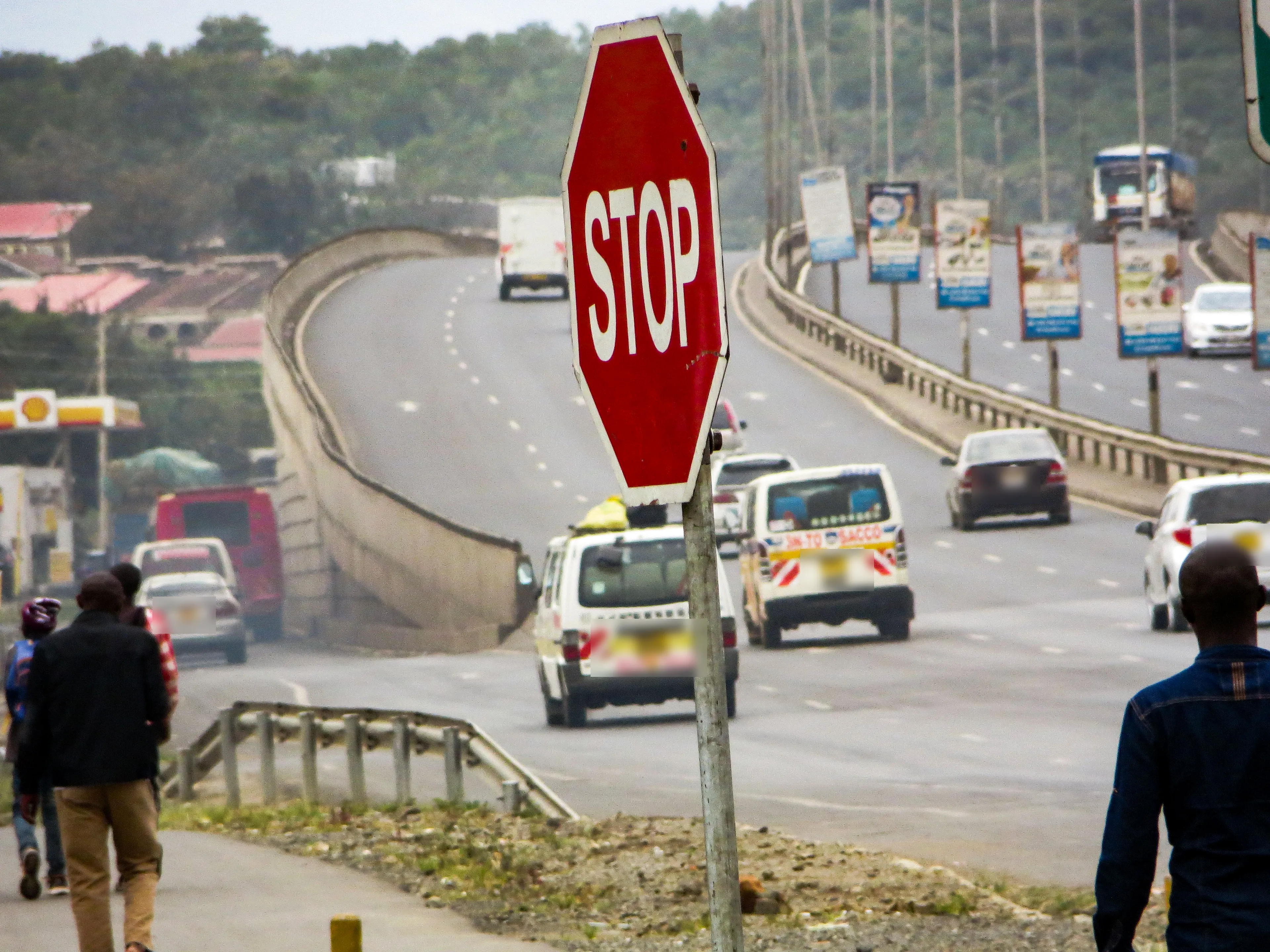
At a STOP sign you must:
- A. Slow down, look right-left-right, and go if clear
- B. Stop only if other vehicles are in sight, then go
- C. Stop fully, look left-right-left, and go on only if clear
- D. Stop fully, look right-left-right, and go only if clear
Answer: D. Stop fully, look right-left-right, and go only if clear. STOP is mandatory. Make a full stop, look right-left-right, and proceed only when the road is clear.
Sources
Read next
Ready for the NTSA test?
Short units, real road situations and timed mock exams. Pay with M-Pesa.